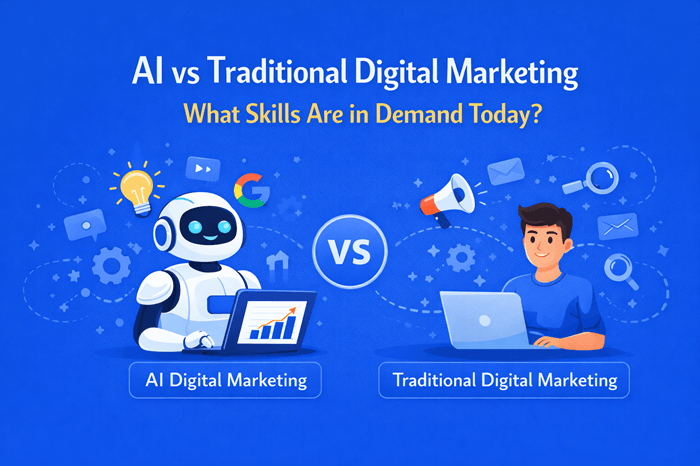
The digital marketing industry is evolving rapidly. Over the last decade, businesses relied heavily on traditional digital marketing strategies such as SEO, social media marketing, and paid advertising. However, the rise of Artificial Intelligence (AI) has dramatically changed how marketing works.
Today, companies are not only looking for marketers who understand digital platforms but also professionals who can use AI-powered tools, automation, and data analytics to improve marketing performance.
Platforms like Facebook, Instagram, and tools such as ChatGPT and Google Analytics are helping marketers create smarter campaigns, automate tasks, and analyze data more effectively.
In this article, we will explore the difference between AI digital marketing and traditional digital marketing, and discuss the most in-demand skills marketers need today to succeed in this competitive field.
Understanding Traditional Digital Marketing
Traditional digital marketing refers to the methods that marketers have used for years to promote products and services online. These strategies mainly rely on human effort, manual analysis, and experience-based decision making.
Some common traditional digital marketing methods include:
- Search Engine Optimization (SEO)
- Social Media Marketing
- Email Marketing
- Pay-Per-Click Advertising
- Content Marketing
- Affiliate Marketing
While these methods are still effective, they often require a lot of manual work and time to analyze performance and optimize campaigns.
For example, marketers previously had to manually analyze data from campaigns, adjust targeting, and test multiple strategies to find what works best.
What is AI Digital Marketing?
AI digital marketing refers to the use of Artificial Intelligence technologies to automate marketing tasks, analyze customer behavior, and improve campaign performance.
AI helps marketers make data-driven decisions instead of relying only on assumptions or manual analysis.
AI tools can perform tasks such as:
- Predict customer behavior
- Personalize marketing campaigns
- Automate content creation
- Optimize ad targeting
- Analyze marketing data in real time
This allows marketers to save time, reduce costs, and improve results.
AI is not replacing marketers; instead, it is helping them become more efficient and strategic.
Key Differences Between AI and Traditional Digital Marketing
Understanding the differences between AI-powered marketing and traditional marketing can help businesses and professionals adapt to the changing industry.
1. Data Analysis
Traditional marketing often requires manual data analysis. Marketers study campaign reports and make decisions based on their observations.
AI marketing tools analyze large amounts of data automatically, identifying patterns and trends that humans might miss.
This leads to more accurate marketing strategies.
2. Personalization
Traditional marketing usually sends the same message to a large audience.
AI allows marketers to create highly personalized marketing campaigns.
For example, AI can recommend different products to different users based on their browsing behavior and interests.
This increases engagement and conversion rates.
3. Automation
In traditional marketing, many tasks must be done manually, such as sending emails or scheduling posts.
AI tools can automate:
- Email marketing campaigns
- Social media posting
- Customer support responses
- Ad campaign optimization
Automation allows marketers to focus on strategy and creativity instead of repetitive tasks.
4. Speed and Efficiency
AI can process data and optimize campaigns much faster than humans.
For example, AI-powered advertising systems automatically adjust:
- Target audience
- Ad placements
- Budget allocation
- Ad creatives
This helps marketers achieve better results with less effort.
Skills Required in Traditional Digital Marketing
Although AI is transforming marketing, traditional digital marketing skills are still very important.
Here are some key traditional skills that marketers need.
Search Engine Optimization (SEO)
SEO is the process of optimizing websites so they rank higher on search engines.
Important SEO skills include:
- Keyword research
- On-page optimization
- Link building
- Technical SEO
- Content optimization
SEO remains one of the most powerful methods for generating organic traffic and long-term leads.
Content Marketing
Content marketing involves creating valuable content to attract and engage audiences.
Examples include:
- Blog articles
- Social media posts
- Videos
- Infographics
Good content builds trust, authority, and brand awareness.
Social Media Marketing
Social media platforms are powerful marketing channels.
Marketers must understand how to create engaging content and build communities on platforms like:
- YouTube
Social media marketing helps businesses connect with their audience and build brand loyalty.
Paid Advertising
Paid advertising is one of the fastest ways to generate leads and sales.
Marketers must learn how to run advertising campaigns on platforms such as:
- Google Ads
- Facebook Ads
- Instagram Ads
- LinkedIn Ads
Skills required include:
- Audience targeting
- Budget management
- Ad copywriting
- Campaign optimization
Skills Required in AI Digital Marketing
As AI continues to grow, marketers must develop new skills to stay competitive.
Here are some of the most important AI marketing skills in demand today.
AI Tools and Automation
Marketers must learn how to use AI tools that help automate marketing tasks.
Some common AI applications include:
- Content generation
- Marketing automation
- Chatbots
- Data analysis
For example, tools like ChatGPT help marketers generate content ideas, write ad copy, and automate customer responses.
Data Analytics
Data is one of the most valuable assets in digital marketing.
AI tools help analyze customer data and marketing performance.
Marketers must understand:
- Data interpretation
- Customer behavior analysis
- Campaign performance metrics
- Conversion tracking
Analytics tools like Google Analytics help marketers measure traffic, engagement, and conversions.
Marketing Automation
Automation is one of the biggest advantages of AI marketing.
Marketers should learn how to automate processes such as:
- Email marketing sequences
- Lead nurturing
- Customer follow-ups
- Social media posting
Automation saves time and improves marketing efficiency.
AI-Powered Advertising
Advertising platforms are increasingly using AI to optimize campaigns.
Marketers must understand how AI works in advertising platforms like:
- Facebook Ads
- Google Ads
AI automatically analyzes user behavior and shows ads to the most relevant audience.
Marketers who understand how to use AI-driven advertising tools can achieve better ROI on ad campaigns.
Prompt Engineering
Prompt engineering is becoming a valuable skill in AI marketing.
It involves writing effective prompts to get better responses from AI tools.
For example, marketers can use prompts to generate:
- Blog articles
- Marketing strategies
- Social media content
- Ad headlines
Learning how to interact with AI tools effectively can significantly improve productivity.
Why AI Marketing Skills Are in High Demand
The demand for AI marketing professionals is increasing because businesses want to improve marketing efficiency and results.
Companies prefer marketers who can:
- Use AI tools effectively
- Analyze marketing data
- Automate campaigns
- Generate better marketing strategies
Professionals with both traditional marketing knowledge and AI skills are highly valuable in the job market.
The Future of Digital Marketing Skills
The future of marketing will combine human creativity with AI technology.
While AI can automate tasks and analyze data, human marketers are still needed for:
- Creative strategy
- Brand storytelling
- Emotional connection with audiences
- Marketing innovation
Successful marketers in the future will be those who can combine creativity with AI-powered tools.
This combination will allow businesses to create smarter marketing campaigns and achieve better results.
Conclusion
Digital marketing is rapidly evolving with the rise of Artificial Intelligence. While traditional marketing skills like SEO, content creation, social media marketing, and paid advertising remain important, AI is adding a new layer of efficiency and intelligence to marketing strategies.
AI-powered tools help marketers analyze data faster, automate repetitive tasks, personalize campaigns, and optimize advertising performance. As a result, businesses are increasingly looking for professionals who understand both traditional digital marketing and modern AI technologies.
For anyone looking to build a successful career in marketing today, the best approach is to combine traditional marketing expertise with AI-driven skills. By learning how to use AI tools alongside core marketing strategies, marketers can stay competitive and take advantage of the exciting opportunities in the future of digital marketing. 🚀
