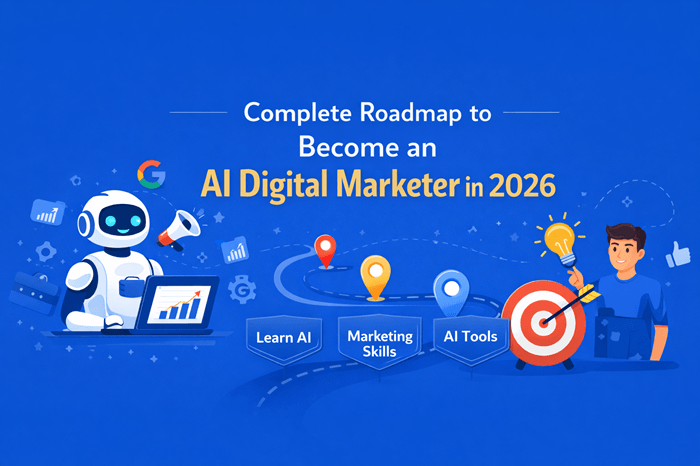
Digital marketing is evolving faster than ever before. In 2026, Artificial Intelligence (AI) has become a powerful force that is transforming how businesses attract customers, run campaigns, analyze data, and automate marketing tasks. Companies today are no longer relying only on manual marketing strategies; instead, they are using AI-powered tools to improve efficiency, personalization, and performance.
Because of this shift, the demand for AI Digital Marketers is increasing rapidly. Businesses need professionals who understand both digital marketing strategies and AI technologies. If you want to build a future-proof career, becoming an AI Digital Marketer is one of the best choices in 2026.
In this guide, you will learn the complete roadmap to become an AI Digital Marketer, including the skills you need, tools you should learn, and the step-by-step path to build a successful career.
Understanding AI Digital Marketing
AI Digital Marketing refers to the use of artificial intelligence technologies to improve marketing performance, automate processes, and deliver personalized customer experiences.
AI can analyze large amounts of data, predict user behavior, optimize advertisements, and generate marketing content automatically. Instead of spending hours analyzing reports or creating campaigns manually, marketers can use AI to make smarter decisions quickly.
For example, AI tools can:
- Generate blog content and social media posts
- Optimize advertisements for better conversion
- Analyze customer behavior and trends
- Automate email marketing campaigns
- Create personalized marketing strategies
This combination of marketing knowledge and AI technology creates a new professional role known as the AI Digital Marketer.
Step 1: Learn the Fundamentals of Digital Marketing
Before using AI in marketing, it is important to understand the core principles of digital marketing. AI tools are powerful, but they work best when marketers know the strategy behind campaigns.
Start by learning the following areas:
Website Development
A website is the foundation of online marketing. Every business needs a professional website to generate leads and build credibility. Learning how websites work will help you understand landing pages, conversion optimization, and user experience.
Social Media Marketing
Platforms like Instagram, Facebook, and LinkedIn are essential for brand awareness and customer engagement. Social media marketing involves content creation, audience targeting, and analytics.
Search Engine Optimization (SEO)
SEO helps websites rank higher on search engines such as Google Search. Learning keyword research, on-page optimization, and backlink strategies will help you drive organic traffic to websites.
Paid Advertising
Paid ads help businesses reach targeted audiences quickly. Platforms like Google Ads and Meta Ads Manager allow marketers to create highly targeted advertising campaigns.
Email Marketing
Email marketing is still one of the highest converting marketing channels. Learning email automation and segmentation will help you build long-term relationships with customers.
These fundamental skills are the base on which AI-powered marketing strategies are built.
Step 2: Understand Artificial Intelligence in Marketing
Once you understand traditional digital marketing, the next step is learning how AI enhances these strategies.
Artificial intelligence allows marketers to automate repetitive tasks and analyze complex data faster than humans. AI systems can predict which ads will perform better, which audience is more likely to convert, and what type of content will generate engagement.
Key AI marketing applications include:
- Content generation
- Customer behavior prediction
- Marketing automation
- Chatbots and conversational marketing
- Campaign optimization
Many marketers now use tools like ChatGPT to generate content, marketing ideas, and campaign strategies.
Step 3: Learn AI Marketing Tools
In 2026, marketers are expected to know multiple AI-powered tools that improve productivity and campaign performance.
Here are some important AI tools to learn:
AI Content Creation
AI tools help create blog posts, social media captions, ad copies, and email campaigns quickly. Tools like Jasper AI and Copy.ai are commonly used for content generation.
AI Design Tools
Design tools powered by AI help create graphics, ad creatives, and marketing visuals without professional design skills. Platforms like Canva offer AI-powered design features.
AI Marketing Automation
Automation platforms help marketers manage customer journeys automatically. HubSpot is one of the most widely used marketing automation platforms.
AI Analytics Tools
AI analytics tools analyze campaign data and provide insights for better decision-making. These tools help marketers understand user behavior and optimize campaigns.
Learning these tools will help you work faster and produce better marketing results.
Step 4: Learn Data Analysis and Marketing Strategy
AI marketing is heavily dependent on data-driven decision making. Instead of guessing what works, marketers now rely on data to guide their strategies.
Important data skills include:
- Reading marketing analytics reports
- Understanding conversion rates
- Measuring return on investment (ROI)
- A/B testing marketing campaigns
- Customer journey analysis
Tools like Google Analytics help marketers track website visitors, traffic sources, and user behavior.
When you combine AI tools with strong analytical skills, you can make smarter marketing decisions.
Step 5: Build Real Projects
Learning theory alone is not enough. To become a successful AI digital marketer, you need hands-on experience.
Start building projects such as:
- Creating a marketing website
- Running social media campaigns
- Writing SEO blog articles
- Creating paid advertisement campaigns
- Automating email marketing sequences
- Generating AI-powered content strategies
These projects will help you understand how marketing works in real-world situations.
You can also create a portfolio website showcasing your work, which will help you attract freelance clients and job opportunities.
Step 6: Learn Marketing Automation and AI Agents
In 2026, automation is a major part of digital marketing. AI agents can perform tasks such as lead nurturing, content scheduling, and customer interaction automatically.
Automation tools can:
- Schedule social media posts
- Send automated email sequences
- Respond to customer queries using chatbots
- Generate marketing reports
Automation allows marketers to manage multiple campaigns efficiently while focusing on strategy and growth.
Step 7: Start Freelancing or Apply for Jobs
After building skills and projects, you can start earning through different opportunities.
Career options include:
Digital Marketing Executive
Many companies hire marketers to manage SEO, social media, and online advertising campaigns.
AI Marketing Specialist
This role focuses on using AI tools to improve marketing performance and automate campaigns.
Freelance Digital Marketer
Freelancers work with multiple clients and manage their digital marketing strategies.
Marketing Consultant
Experienced marketers can help businesses create growth strategies and improve online presence.
Platforms like Upwork and Fiverr allow freelancers to find international clients.
Step 8: Continuously Upgrade Your Skills
Digital marketing and AI technologies evolve quickly. Successful marketers constantly learn new tools, trends, and strategies.
Ways to stay updated include:
- Following marketing blogs
- Attending webinars and workshops
- Taking advanced courses
- Experimenting with new AI tools
Continuous learning helps marketers stay ahead in a competitive industry.
Future of AI Digital Marketing
The future of digital marketing is strongly connected with artificial intelligence. In the coming years, AI will become even more advanced and capable of handling complex marketing tasks.
Some future trends include:
- Hyper-personalized marketing campaigns
- AI-generated marketing videos
- Predictive customer behavior analysis
- Voice search optimization
- Fully automated marketing funnels
Businesses that adopt AI marketing strategies will gain a significant competitive advantage.
Conclusion
AI Digital Marketing is one of the most promising career opportunities in 2026. As businesses move toward automation and data-driven strategies, the demand for professionals who understand both digital marketing and artificial intelligence continues to grow.
By following a structured roadmap—learning digital marketing fundamentals, mastering AI tools, understanding data analytics, and building real-world projects—you can build a successful career in this field.
The key to success is continuous learning, practical experience, and staying updated with the latest AI technologies. If you develop the right skills and apply them effectively, you can become a highly valuable AI digital marketer and help businesses grow in the digital era.
With dedication and the right roadmap, anyone can start this journey and build a rewarding career in AI-powered digital marketing. 🚀
